Friday, October 24, 2014

Can God Speak Through a Lama?

This week’s post is in response to Dr. Metzger’s recent Patheos post, Thank God for the Dalai Lama. Dr. Metzger seeks to model engagement of other religions through our convictions rather than around them.

We would be wise to heed all messages from God. In the Bible God spoke to his people a number of different ways, from the pre-fall walking together in the cool of the garden, to entertaining or wrestling disguised angels, dreams, visions, burning bushes, pillars of cloud and fire, donkeys, the Law, whirlwinds, psalmists, and prophets. Others in the New Testament enter into dialogue with Jesus Christ and have their words and actions become part of God’s message for his people today. People like the Samaritan woman in John 4, the Syrophonician woman in Mark 7:25-27, the Centurion in Matthew 8 and Luke 7, the other centurion at the crucifixion who recognized that Jesus must be the son of God, the Jewish teacher Nicodemus in John 3, and even a hated tax collector have their story and message included in that greatest story of all. The Bible says that Jesus Christ is God's final revelation to the world (Hebrews 1:1-3). Yet down through history there have been others who have spoken words of prophetic challenge to the church even through criticism from the outside...words that should direct us back towards Christ. Can we hear the voice of the Spirit blowing unexpectedly through those who don't claim to know Christ?
 
So can God use a Lama to speak truth to Christians? Yes and no. If you are a Tibetan Buddhist you would probably answer, “Yes.” If you are a Christian you would likely say, “No.” But I agree with Metzger that there is room for those opposed to his spiritual beliefs (myself included) to be challenged by God through the Dalai Lama— challenged to see how strongly we value human life and how free we are from bondage to material possessions. Jesus of course teaches both of these points quite clearly.

As one who has been made in the image of God and thus committed to the value of human relationships the Dalai Lama warns us against the impersonal and arrogant and as Metzger notes, “In the midst of his affirmation of scientific progress that furthers the well-being of our planet, he cautions scientists, business leaders and politicians, even society at large, not to play God.” Further Metzger summarizes one of the chapter highlights from the Dalai Lama’s work “Ethics and the New Genetics”,
Knowledge of genetic predispositions of disease may lead one to abort a child whose disease will manifest itself in twenty years; such knowledge of predisposition entails only a probability at best and does not account for the possibility that a cure may be found within ten years (page 191).

The Captain calls for any to join him in the effort against evil.
The thought of such a callous utilitarian consumer ethic as is being made possible by the new genetics reminds me of the Hydra/ S.H.I.E.L.D. Project Insight in the film, Captain America: Winter Soldier when they deployed Zola’s algorithm that would kill every person they considered a threat and every potential threat in the future. In the movie, Captain America was determined to stop such an affront to the humanity of the world, alone if necessary but also was betting that he was not alone. So in some ways the Dalai Lama is joining forces intellectually with the Captain against those that would “play God” over who lives and who dies. I am pretty sure no one has made this comparison before!

Devoted Christians have historically contended for the lives of others over extending their own. Yet in an increasingly temporal focused culture we can be conditioned to defend ourselves rather than display the strength found in biblical meekness (Matt 5:5).
Put on then, as God's chosen ones, holy and beloved, compassionate hearts, kindness, humility, meekness, and patience, bearing with one another and, if one has a complaint against another, forgiving each other; as the Lord has forgiven you, so you also must forgive. (Colossians 3:12-13)

We can be tricked into self-preservation instead of taking up the cross and dying daily participating in the great mission of God.
And he said to all, “If anyone would come after me, let him deny himself and take up his cross daily and follow me. For whoever would save his life will lose it, but whoever loses his life for my sake will save it. (Luke 9:23-24)

Is it not possible that the Dalai Lama who is no follower of Christ, can challenge us to become better followers of Jesus? I think so. If we allow his bold writing to challenge us to stand for the relational value [what we Christians call “the image of God”] in all mankind and simultaneously rethink how tenaciously we are living into the life God has for us, or if we merely love the things of the world too much to share in the love of Christ and need to repent.

I think that we can find lots of ways to work together for the common good humanity despite our clear disagreements. As Dr. Metzger concludes.
By challenging one another, Buddhists, Christians, Jews, Muslims, Hindus and others can help strengthen our collective resolve and response to the challenges we face in search of a truly global ethic affirming all of life. As such, we become “trustworthy rivals”…

Are we humble enough to hear God speak through not just the Dalai Lama but through those thought to be the least likely of messengers…like two guys in the Bible named Saul--one was out hunting donkeys and the other hunting Christians.

Tuesday, October 14, 2014

Bridge-Building 2: "Relational Impact Studies"

[This is a sequel to a previous post, entitled Bridge-building in A Chaotic World.] 

Bridge-building with other cultures and people from other religious backgrounds must start with asking a few questions and then taking time to really listen. What is their story? Who are their family? What brings them joy or sadness? What is their direction, their goal that they are seeking? What are some of the most deeply held values that assist them in their life journey? I am also interested in their impressions of Christianity and Christians prior to this time and what has formed those opinions.

If we don’t ask and then sit quietly to listen over coffee or tea how will we know where to start building a bridge or if it is necessary? Perhaps there are strong bridge members already in place that need to be identified. There are a couple of things we can do that will sabotage the pre-building process. The first thing is to treat the listening process as a means to a unilaterally desired end. As impatient task-oriented Westerners, we often want to cut through the relational ceremony and get down to business. But what if the other person considers the relational ceremony as a business?
A second thing we can do that will render the listening stage non-relational is if we are listening only as a means to know what to say in response. Many years ago I used to view a conversation like a chess match and would be thinking at least a couple of responses ahead. I swore it off as violating one of my core values, that of hearing and being heard. People can tell the difference between a dialogue and a disguised monologue so we need to stop fooling ourselves.

While individualism is rooted in interests, personhood is tied to relationships. If we are going to have a relationship then we must fully listen to one another without feeling the compulsion to rebut, correct, fix, or persuade them to another point of view. Certainly, that may come as we acknowledge our respective convictions, but it must not be the purpose of our “listening.”

As I mentioned in a previous post when building a bridge the builders need to pick the right site, materials, and design. Similarly, if I don’t make myself teachable to those I am trying to connect then the relational "bridge" will in some way fail to deliver that which it promises. If we can’t be trusted to safely treasure the story, needs, and longings of others then our efforts at bridge-building will be seen more as an invasion and an occupation rather than an authentic connection.

My late father was a wildlife biologist and wetlands scientist who made his living doing environmental impact studies that must occur before any major construction project. It seems to me that the listening phase of bridge-building is somehow like a relational environmental impact study.

How can I learn what God is already doing in a person’s life if I don’t take time to sit and listen and watch? How can we assess how our efforts to “help” may actually hinder if we don’t listen to the still small voice of the Lord amidst our relentless pressing forward with our projects? I recently sat with a businessman who confessed to being a terrible listener and being bothered by that flaw. He was right. He was loud, opinionated, and more interested in what he had to say than what I was saying. But at least he was honest about the prevailing winds in his relationships and how they would affect any bridge-building in his life. He also desired to change and had opened his life to be mentored in this area.

Some have grown cynical from the too frequent “public meetings” hosted by our elected officials where they never seem to really care what the public says unless it agrees with what leaders have already made up their minds to do. Has the world grown cynical towards our Christian efforts at bridge-building because we don’t listen (or are perceived not to listen)? I don't want to contribute to such impressions.


Photo by Kayle Kaupanger on Unsplash

If these concepts resonate with you, Multnomah Biblical Seminary offers both a MA in Applied Theology and a Doctor of Ministry degree that incorporates such issues of cross-cultural engagement. This post is a sample of something that was initially written as a class assignment for that program. I invite you to check out this bridge-building program as a paradigm for the ministry of God's unchanging love in the midst of this changing world.

Also, a listening-related post that looks at whether God hears our deepest cries can be found in Psalm 22 “Unanswered Call… Answered”.

Friday, October 10, 2014

Bridge-building in a Chaotic World

Tilikum Crossing "The People's Bridge",
a controversial new bridge in Portland, Oregon
Why do we need bridges? So the people can cross over something in their environment that divides them—like a canyon, river, or other body of water. Probably the first thing to be decided in building a bridge is if one is needed and wanted, secondly we need to ask who is going to pay for it. Once these questions have been addressed a bridge builder needs to know something about the forces (loads) that a bridge must withstand.
·         Dead loads that don’t move or change, the weight of the bridge itself.
·         Environmental loads that include hydraulic friction, seismic stability, and wind.
·         Live loads referring to temporary or moving forces (e.g., traffic), etc.

I frankly don’t want someone building a bridge that doesn’t know anything about engineering, geology, local weather, and the needs of the people it is designed to serve. Do you remember the famous debate over the very expensive “bridge to nowhere” in Ketchikan, Alaska? Right here in the Portland metro area, we have the failed Columbia River Crossing (CRC) an effort to build a very expensive bridge without solving a problem, and without the support of the population as an exercise in a government’s agenda being forced on the people. Thankfully it has been stopped, but approximately $240M of the people’s money was wasted on this project.

Obviously, my question isn’t really about building physical bridges but about building relational bridges, bridges of understanding, forgiveness, and reconciliation between individuals, groups, races, and nations. So why talk about the engineering of physical bridges? Because many of the same issues come into play when trying to metaphorically "build bridges" between people(s).  

As we build relational bridges, we first must ask if a bridge is needed. Bridges should not be built any further than they are wanted. Having a bridge spanning our defensive separation is scary if we don’t fully trust those people on the other side. If we seek to bring people together then we had better make sure we are not placing one group at a greater risk for oppression (2 Timothy 3:2-5). The bridge must be for the benefit of both parties.
Building a bridge also takes time. A physical bridge not only has to be planned, and built, but it has to be maintained against structural degradation due to the normal stresses of use and environmental stresses from corrosion, freezing, temperature fluctuation, insects, etc. Sometimes bridges cannot safely be crossed quickly. Are relational bridges so different? We all know that relationships take constant work to maintain. So how do we pass on the passion for maintaining relational bridges to the next generation? (2 Timothy 2:1-2).

Bridge-builders also need to be concerned about the safety of those working on the bridge as well as those who will use the bridge in the future. Do we care that some of those working with us might “fall off” during construction? When the Golden Gate Bridge was built in the 1930s they pioneered the use of hard hats and safety nets. Do we have a safety net in place for our relational bridge-builders that is at least as effective as when the Golden Gate Bridge was constructed? Or, are co-builders merely commodities to be used up, expendable resources before the overarching goal of completing the task?

Tragic bridge collapses in recent years cause me to warn against bridges being built too quickly on the unstable soil of assumption and misunderstandings. Recently, newly constructed highway bridge columns had to be blown up after it was discovered that they were built on unstable ground. Without measuring the cultural distance that needs to be spanned, doing the seismic mapping of past offenses, and completing the site preparation of building trust, the bridge is doomed to fall beneath the weight of the forces arrayed against it. When building relational bridges we need to count the cost as well. Is this bridge worth the cost it takes to build, or does it lead nowhere? (2 Timothy 2:23) Do we evaluate the process and participants on a worldly level or according to the metrics of Christ? (1 Samuel 16:7; 2 Cor. 5:16-17) Jesus, the ultimate bridge-builder, became one of us and completed the task not by force of power or decree of authority, but by the humble giving of himself to save others. Our calling is to follow his uncomfortable example in showing reconciling love for others.

I will explore some of these questions in future posts. I welcome your comments along the way. In the meantime, Ephesians 4:31-32 gives us a great place to start building, preparing to be safe, bridge-worthy people that others would welcome into their neighborhood. “Let all bitterness and wrath and anger and clamor and slander be put away from you, along with all malice. Be kind to one another, tenderhearted, forgiving one another, as God in Christ forgave you.”
Golden Gate Bridge in Fog

Tuesday, September 30, 2014

Moving Day Part 1 “Packing Up”

Photo by Kadarius Seegars on Unsplash
As I get ready to move on to a new focus in my cultural engagement blogging, I thought I might pack up some things to share, and perhaps stir my readers up by way of reminder.

Over the summer, in a loose-knit series of blog posts, I explored the concept of unity and disunity in our society and how we as the church should be committed to tearing down the walls that we allow to divide us so that we can better represent as the body of Christ on earth. Some of this disunity is tied to the literal building and tearing down of walls and the movements of ethnic peoples from one land to another, and some of the disunity is because of our own pride and sense of entitlement.

Starting with Some Elbow Room? (7/15/14) I asked questions like, “Why do we always seem to push others out when we move in (whoever the “we” may be)? Why do we spend so much energy "clearing the land" to build our own kingdoms?” and encouraged Christian congregations to stop competing with each other as well as trying to be self-sufficient and start working together. I concluded that post with the challenge,
If we need to be moving someone, let it be moving ourselves closer to each other relationally, linking arms and hearts, keeping in step with the Spirit rather than the flesh (Gal. 5). Listen to one another, pray with one another, and be friends with one another. Then we may see God move in gentle power in our midst... and have to move out into the yard because the house isn't big enough for everyone.

I followed that with Dust in the Wind: The Ever-Changing Dance (7/22/14) in which I talked about the fascinating way that ethnic populations have always been moving and shifting, not as a way to excuse the gentrification of traditionally non-white urban communities, but as an encouragement for us to consider how our policies and actions affect others. Though this shift is unavoidable we should not force it on others.
“Sudden heavy-handed shifts in demographics can either bury the existing community under the weight of new arrivals (think our current crisis on the Southern Border) or scatter that community to the wind (think N & NE Portland)…  

The question facing us is how to respond. Will we embrace the shift and adapt to the new ministry opportunities that the wind has delivered to our doorstep (or to whose doorstep we are delivered)? Will we flee to new lands (California or Bust!) to begin again? Or like some die-hard Dust-Bowlers will we simply live in the basement of what remains and slowly watch our family die of dust pneumonia?

More recently I looked at how we view the “property lines” in our own lives in Psalm 16:5-8 "Pleasant Places" (8/5/14). This passage alludes to the tribal inheritances allocated in the Book of Joshua, but then applies the idea of inheritance not to a place but to a person—the Lord himself. But out of this story, we see our collective responsibility to help every “tribe” to gain its inheritance.
“Who has yet to receive a piece of the pie? Who has not been given a place at the table? For such as these those of us who have access to economic and educational resources should look for ways to leverage them not for our own benefit, but for the benefit of those who don’t have the same options available to them.”

So how do we do this? Trust God and do what he is doing. Our natural response is to take the easy way rather than the hard one. The mission of God is greater than the appearance of “the neighborhood”. Everything God does has a purpose and though it might not be what we want, it is for the good. So do we lament what we see and complain our days away or do lean in and listen more closely to the voice of the Spirit? Do we run from the sound of suffering or do we run towards the battle for the good of the oppressed?
Yesterday I wrote to my son that some of the imagery in Isaiah 62 seemed a little like the rebuilding that must happen after a terrorist attack.  
Go through, go through the gates,
Clear the way for the people;
Build up, build up the highway,
Remove the stones, lift up a standard over the peoples.
Behold, the Lord has proclaimed to the end of the earth,
Say to the daughter of Zion, “Lo, your salvation comes;
Behold His reward is with Him, and His recompense before Him.”
(Isaiah 62:10-11)
There was an attack, a disaster, a tragedy. I wonder if we are willing to move, coming alongside to help our new neighbors overwhelmed with the debris of a violently fallen world. Or would we rather use the remote control to change over to the Cartoon Network?

In the incarnation, Jesus chose the hard way of becoming human to rescue us in accordance with the redemptive plan of God. The least we can do is follow his lead going out from comfort, convenience, and status quo, to take up the missional calling he has given to us.

So Jesus also suffered outside the gate in order to sanctify the people through his own blood. Therefore let us go to him outside the camp and bear the reproach he endured. For here we have no lasting city, but we seek the city that is to come. Through him then let us continually offer up a sacrifice of praise to God, that is, the fruit of lips that acknowledge his name. Do not neglect to do good and to share what you have, for such sacrifices are pleasing to God. (Hebrews 13:12-16)

Just because we “have no lasting city” here doesn’t mean we can’t leave a lasting mark!

Friday, September 26, 2014

The Gates of... Shall not Prevail!

[This post is an assigned response to Dr. Paul Metzger’s article, Gated Communities and the Visible/Invisible Church. It may, or may not be, helpful to read his post first.]

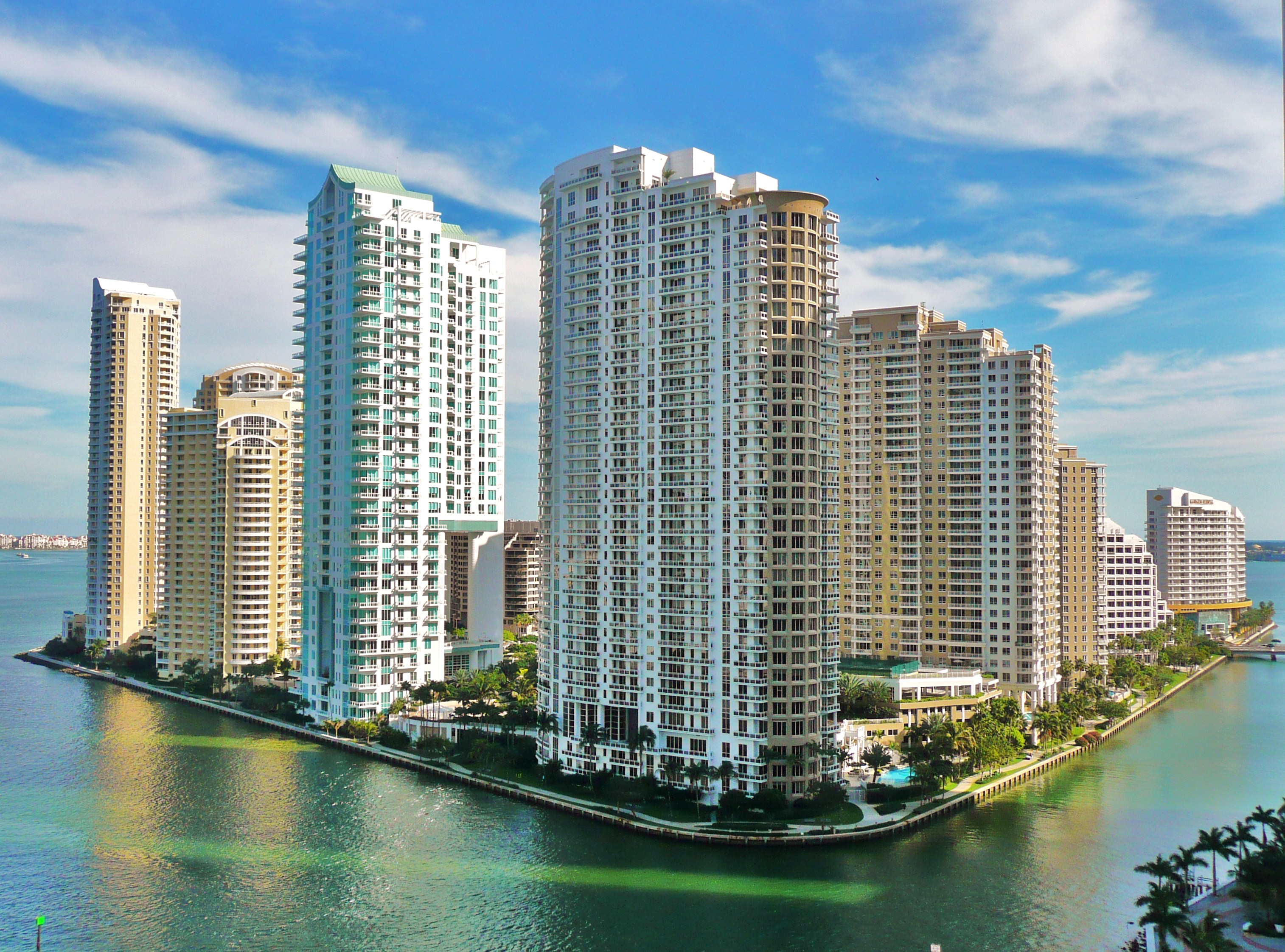
Brickell Key from north.
Photo by Marc Averette
Dr. Metzger uses the metaphor of “gated communities” two ways. First he uses it for the divisions and “Keep out” signs we put up in our lives and especially in our churches. There was a church growth principle popular in the 1980s-90s call the Homogeneous Unit Principle. This taught that the fastest way to grow a church was with people of the same race, class, education, interests, etc. The problem with this principle is that it works because it makes use of our natural worldly responses and has led many to keep using it. It is comfortable. It is safe. It keeps those without the gate code out. Who knows what might happen if we let everybody in… it might lead to the zombie apocalypse! OK so that last part was hyperbole.

The real problem with this gated community approach is that it is not Jesus’ way. His approach in the incarnation—God coming to the world in the flesh—was what we would call “downwardly mobile”. He came to minister to, spend time with, and suffered a brutal death to save everyone who would come. How willing are our churches to follow his example?

The second way he uses gated community metaphor for the invisible church that doesn’t engage the world around it. This happens two ways. Some people think that they can be Christians without functioning in community as the church. And some churches think they can be Christian inside their safe little spiritual compound without being a part of the larger culture and community. This may seem safe considering the things that go on “out there” but it is also an act of disobedience to Jesus’ command to go, preach, and disciple the whole world.

Don't Back Up!
We are not called to back up, circle the wagons, and hold the fort just because we are no longer in charge of the cultural forces around us. Instead of going all Elijah (1 Kings 19:14,18) and thinking we are the last true Jesus-followers on earth. If we take time to look and listen we will see God at work in some pretty amazing ways. This is not a call to compromise for as Dr. Metzger repeatedly states, “When engaging our culture, we must always go through our convictions, never around them, and never stopping short at them.” It seems to me that by not engaging we are stopping short of being truly biblical, fully orthodox, and faithful followers of Jesus.
So what gates have we placed in the way of those who God is calling to himself? What prevents us from gathering in unity as the visible Church?  Metzger suggests that,

"Perhaps some churches exclude people of other ethnicities, economic brackets, those with “disabilities,” the elderly or young or singles, the vibrant or dying, or those with different worship styles,  personality types, hobbies, IQ’s, and political perspectives."

But Jesus came to make us one, where all our gifts serve the unity of the congregation and all the “giftedness’s” of the local expressions of the Church contribute to the one Church, the visible body of Christ on earth. And I hate to break it to the gate-keepers and the spiritual HOA people, but the Church can’t be contained within your walls. Come out and join it in the great mission of God. It is risky and sometimes messy, but it smells like heaven.

Not only do we need to come out and collaborate with the wider church to engage the world but we also need to open the gates to welcome others inside to share life with us. It is wonderful to hear that many churches today are working towards a more multi-ethnic ministry model that better represents the church as it will be when Christ returns.
And they sang a new song, saying,
“Worthy are you to take the scroll
    and to open its seals,
for you were slain, and by your blood you ransomed people for God
    from every tribe and language and people and nation,
and you have made them a kingdom and priests to our God,
    and they shall reign on the earth.” (Rev. 5:9-10)

But there is a barrier that is still up in many areas and it is primarily socio-economic, as I wrote in my last post Poor Praise Indeed. Honestly, how welcome do the poor of our community feel to come not just to get help but to fully participate in our gatherings? I am disturbed afresh by Jesus' parable in Luke 16:19-31 of the rich man who let a poor sick man named Lazarus die un-served and un-welcomed at his gate. I don’t want to minimize the efforts we make to go to minister to the poor—both foreign and domestic—but do we let the poor minister to us… and worship with us in our churches? Or have we settled for something less in a gated community?

In next week’s post, entitled Moving Day, I will bring this section on unity to a conclusion before taking up the next topic—Diplomacy.